
Wood Floor Acclimation – The Foundation of a Lasting Installation
Published January 15, 2026 | Hartco Flooring Experts
Walk into any home with beautiful wood floors, and you’re looking at more than just a skilled installation. You’re seeing the result of careful preparation that happened days before the first board went down.
That preparation is acclimation, and it’s the difference between floors that perform flawlessly for decades and floors that develop problems within months.
Key Takeaways:
- Acclimation balances wood moisture content with your home’s environment
- Most hardwood requires acclimation based on the moisture content of the wood and the subfloor
- Moisture meters and hygrometers help determine true acclimation, not elapsed time
- Proper acclimation prevents gapping, cupping, buckling, and warranty issues
- Your home must reach normal living conditions before flooring arrives

The Science Behind Wood Movement
Understanding acclimation starts with understanding wood itself. Even after harvesting, milling, and finishing, hardwood remains a living material in one critical way. It constantly exchanges moisture with the surrounding air.
Scientists call this property hygroscopic behavior. In practical terms, it means your floors are constantly responding to the humidity around them.
When indoor humidity climbs, wood fibers absorb moisture from the air and expand. When humidity drops, those same fibers release moisture and contract. This action isn’t a flaw in the material. It’s fundamental to how wood behaves.
“Wood always seeks moisture balance with its environment. If flooring enters a home before reaching that balance, the adjustment happens after installation. That’s when homeowners see problems emerge.”
— Travis Bjorkman, Principal Scientist for Wood, AHF
The moisture content that wood naturally settles into is called equilibrium moisture content, or EMC. Acclimation is simply giving wood the time it needs to reach that equilibrium point before you lock it into place on your subfloor.
What Makes Acclimation of Wood Flooring Non-Negotiable
Many installation steps offer some flexibility. Acclimation doesn’t.
Skip it, and the flooring will adjust to your home’s conditions anyway. Except now those adjustments happen after the boards are secured to the subfloor, after the expansion gaps are set, and after the finish work is complete.
The True Cost of Skipping Acclimation
The financial impact of acclimation failures can be significant.
According to Angi’s hardwood floor repair cost data, gapping repairs cost between $7 and $15 per square foot, while cupping repairs range from $1 to $8 per square foot.
HomeGuide reports that complete floor replacement for water damage and buckling can run from $2,000 to $10,000 or more for typical residential installations.
Perhaps more concerning: many manufacturer warranties specifically require documented acclimation. Many flooring manufacturers explicitly state that damage from improper acclimation voids warranty coverage.
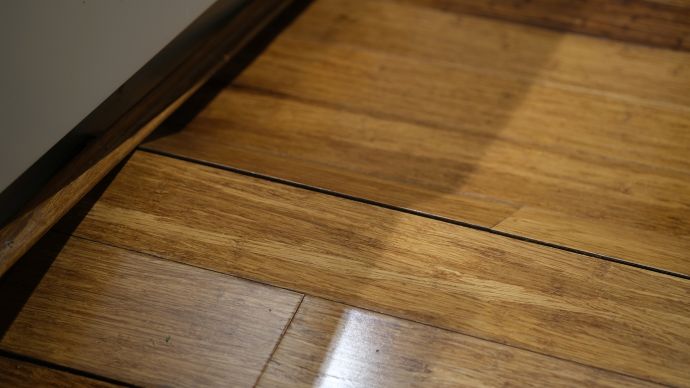
5 Types of Damage from Wood Flooring Movement
That’s when movement transforms from an invisible process into visible damage:
- Shrinkage creates gaps: If the flooring dries out after installation, the boards contract and pull apart, leaving unsightly gaps between planks.
- Expansion causes buckling: When boards absorb moisture after being nailed down, they swell with nowhere to go. The result is lifted planks, raised edges, and ridges across the floor surface.
- Moisture imbalance leads to cupping: When one side of a board absorbs more moisture than the other, edges lift higher than centers, creating a concave surface.
- Prolonged stress results in permanent warping: Once dimensional changes become severe enough, boards lose their original shape entirely. At that point, sanding won’t fix the problem. Only replacement will.
- Repairs become expensive and incomplete: Wood that has already distorted rarely returns to its original form. Most failure scenarios require removing and replacing affected sections, often at considerable cost.
Engineered Hardwood: Still Requires Acclimation
A common misconception suggests that engineered hardwood doesn’t need acclimation because of its layered construction. As a best practice, allow for acclimation.
Why?
Engineered floors do offer greater dimensional stability than solid hardwood, but they’re not immune to environmental changes. The surface layer is genuine hardwood veneer and exchanges moisture with indoor air, just like any solid plank.
Equally important, the core layers, whether plywood or high-density fiberboard, also respond to changes in humidity.
“Engineered hardwood moves less dramatically than solid planks, but it still reacts to its environment. The veneer on top is real wood, and beneath it, the entire core structure is wood-based material that can shift in moisture content.”
— Travis Bjorkman, Principal Scientist for Wood, AHF
Engineered Hardwoods Require Less Acclimation Time
The difference isn’t whether engineered products need acclimation. It’s that they typically reach moisture equilibrium faster than solid wood, often within 48 to 72 hours, rather than the 3 to 10 days solid planks require.
But “faster” doesn’t mean “optional.” As a best practice, engineered flooring still needs time to stabilize before installation begins.
How Long Should Wood Floors Acclimate?
There’s no universal timeline that applies to every situation. Acclimation time depends on three variables:
- The type of flooring
- The species of wood
- Your home’s current conditions
Here’s what to expect under typical residential conditions:
| Flooring Type | Acclimation Range |
| Solid hardwood | 3-10 days |
| Engineered hardwood | 48-72 hours |
| Exotic species | Up to 14 days |
These ranges assume your home is already at normal living conditions. In regions with extreme humidity or dryness, or when storing flooring in uncontrolled environments, timelines may be extended.
But here’s what matters most. Acclimation ends when moisture readings stabilize, not when a certain number of days has passed.
Time alone doesn’t acclimate wood. Moisture balance does.
Measuring True Acclimation
Professional installers don’t guess. They measure.
Acclimation is complete only when the flooring’s moisture content matches both the room environment and the subfloor it will rest on. That requires three specific measurements:
Temperature Stability
Your home should maintain a consistent temperature between 60°F and 80°F. That range must reflect everyday living conditions, not temporary heating or cooling. Intermittent climate control doesn’t count.
Relative Humidity Range
Indoor humidity should stay between 30% and 50%. Brief fluctuations are normal, but the environment must remain within this range long enough for wood to stabilize.
According to the EPA’s indoor air quality guidelines, whole-house humidity should fall between 30% and 50% to prevent both dryness issues and microbial growth.
“Most homeowners don’t realize their HVAC system is doing more than controlling comfort. It’s actively protecting its hardwood investment. Consistent climate control isn’t optional. It’s the infrastructure that makes acclimation possible.”
— Travis Bjorkman, Principal Scientist for Wood, AHF
Moisture Content Balance
For most residential hardwood installations, the target moisture content falls between 6% and 8%. Wagner Meters explains that the acceptable wood moisture content ranges typically from 6-8% for most North American applications, with slight regional variations.
More important than hitting a specific number is achieving consistency between the flooring and subfloor.
Installers use moisture meters and hygrometers to check both surfaces. The acceptable difference depends on plank width:
- Wide planks (over 3 inches): Within 2% of subfloor moisture content
- Narrow boards: Within 3% if environmental conditions are stable
Once these readings remain steady over several consecutive days, acclimation is complete.
“Time is a guideline. Moisture content is the determining factor. Until readings stabilize and match the subfloor, acclimation hasn’t occurred.”
— Travis Bjorkman, Principal Scientist for Wood, AHF
5 Steps to Prepare Your Home Before Flooring Arrives
Acclimation can’t begin until your home is ready to receive the flooring. That means creating stable living conditions before delivery day.
For at least 48 to 72 hours before flooring arrives:
- Run your HVAC system continuously: Don’t rely on intermittent heating or cooling. The system needs to maintain consistent temperature and humidity.
- Keep the space enclosed: Windows and doors should remain closed to prevent outdoor air from affecting indoor conditions.
- Maintain target ranges: Temperatures should be between 60-80°F, with relative humidity between 30-50%.
- Finish all wet construction work: Fresh paint, drywall compound, and concrete all release moisture into the air. These projects must be complete and thoroughly dried before flooring enters the space.
- Check the subfloor condition: Measure subfloor moisture content and inspect for any wetness, damage, or irregularities. Address problems now, before flooring arrives.
If your home hasn’t stabilized, your flooring can’t either.
The Acclimation Process: Step by Step
Once your home meets the environmental requirements, proper acclimation follows a specific sequence.
Step 1: Immediate Delivery to Installation Site
The moment the flooring arrives, bring it directly into the room where you will install it. Don’t leave boxes in the garage, on the porch, or in an unheated basement. The wood must acclimate to the exact space where it will live permanently.
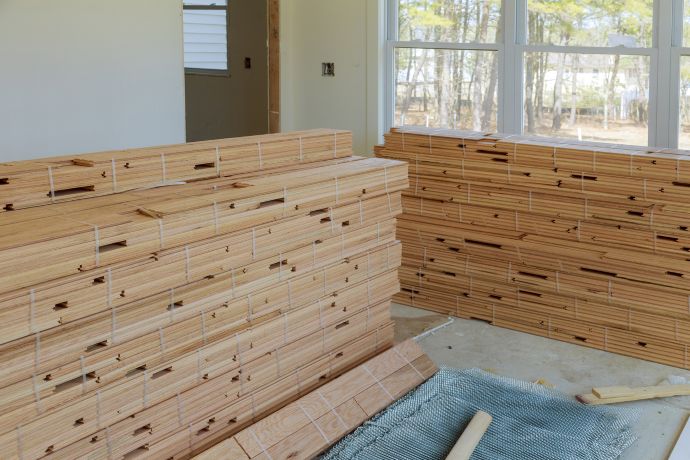
Step 2: Remove All Packaging
Wood cannot adjust inside sealed boxes. Plastic wrap traps moisture. Cardboard restricts airflow.
At a minimum, open every carton and remove protective plastic to promote air circulation. Better yet, remove planks entirely and cross-stack them in small piles, elevated off the subfloor with spacers between boards. Position stacks away from exterior walls where temperature fluctuations are more pronounced.
The goal is to allow air to circulate on all sides of every plank.
Step 3: Monitor Moisture Readings Daily
Check both the flooring and the subfloor moisture content each day. Record the numbers. Look for the readings to stabilize and converge within acceptable tolerances.
Step 4: Wait for Equilibrium
When the moisture content stops changing, and the difference between the flooring and subfloor falls within guidelines, installation can safely proceed.
That’s when your floor and home have synchronized. Everything that follows builds on this foundation.
Regional Climate: Why Location Matters
Seasonal changes aren’t the only factor affecting moisture content. Geography plays a significant role, too.
Different regions across North America experience vastly different baseline humidity levels, which means wood flooring in Phoenix behaves differently than flooring in Miami or Portland.
Regional Moisture Content Patterns
Wagner Meters’ EMC map of North America shows average moisture content percentages across the continent for interior wood use. The chart below summarizes Wagner’s findings, illustrating how dramatically moisture conditions vary by region and season.
EMC Ranges by Location
| Region Type | Typical EMC Range | Geographic Areas | Flooring Challenges |
| Arid regions | 4-7% | Mountain West, Southwest | Shrinkage, gapping, surface checking |
| Moderate regions | 6-9% | Central and Northern US | Seasonal swings, managing expansion/contraction cycles |
| Humid regions | 9-13%+ | Southeast, Gulf Coast, Coastal areas | Cupping, crowning, and persistent moisture absorption |
Source: Wagner Meters
Understanding your region’s typical moisture patterns helps you set appropriate acclimation targets and prepare for the seasonal movement your floors will experience over their lifetimes.
“Every region has unique moisture characteristics. A floor installed in Colorado will behave differently from one in Georgia, even with perfect acclimation. Understanding your local environment is essential.”
— Travis Bjorkman, Principal Scientist for Wood, AHF
Your installer should factor regional climate into acclimation targets and moisture content goals.
How Seasons Influence Wood Floors
Even after installation, hardwood continues to respond to seasonal changes in humidity. This behavior is expected. Proper acclimation ensures that seasonal movement stays within acceptable limits.
Understanding Seasonal Humidity Patterns
According to Today’s Homeowner, recommended indoor humidity varies by season: 30-40% relative humidity in winter months, and up to 50% in summer.
Wagner Meters notes that most North American homes run at approximately 6% EMC in winter and 9% EMC in summer due to fluctuations in humidity.
Summer: Heat and Humidity Expansion
During warmer months, indoor air holds more moisture. Wood absorbs it quickly, causing planks to swell slightly. In homes without air conditioning, humidity can swing dramatically throughout the day, leading to more pronounced edge lifting and cupping.
“Summer installations require extra vigilance. When you’re bringing wood into a humid environment, ensure it reaches its swollen state during acclimation, not after the floor is down. Otherwise, you’re installing a floor that’s going to keep expanding.”
— Travis Bjorkman, Principal Scientist for Wood, AHF
Winter: Dry Air Contraction
Heating systems remove moisture from indoor air. As humidity drops, wood releases moisture and contracts. This seasonal shrinkage can create small gaps that weren’t visible during the summer months. Even well-installed floors show some natural seasonal movement.
The key difference is that when you acclimate wood floors adequately before installation, they’ll breathe naturally within normal limits. Floors that aren’t acclimated experience more dramatic, potentially damaging movement.
The Cost of Cutting Corners
Some installers rush acclimation to meet tight deadlines. Some homeowners want the project finished quickly and pressure installers to skip steps.
Both scenarios create risk.
Skipping acclimation might save a few days on the front end, but it often leads to failures that surface weeks or months later when fixing them is far more expensive and disruptive.
“The cruelest part of acclimation failures is the delayed timeline. Homeowners see a beautiful floor on installation day. Problems don’t surface for months, making it harder to connect cause and effect. But the physics don’t lie—improper acclimation always catches up.”
— Travis Bjorkman, Principal Scientist for Wood, AHF
Rejected Manufacturer’s Warranties
Most manufacturer warranties specifically require proper acclimation. Without documented moisture readings and adequate acclimation time, manufacturers may deny warranty claims for gaps, cupping, or buckling.
Hellmuth & Johnson law firm documented multiple real-world cases in which manufacturers declined warranty claims due to improper moisture conditions during installation or to failure to acclimate the flooring properly.
The floor might look perfect on installation day. Problems rarely appear immediately. They emerge gradually as the wood continues to adjust to conditions it should have already matched.
What Proper Acclimation Delivers
When done correctly, acclimation provides benefits that extend far beyond avoiding problems.
- Cleaner installation: Boards that have already adjusted to their environment fit together more precisely. Installers spend less time correcting issues.
- Enhanced stability: Seasonal movement remains minimal because the floor started from an equilibrium state.
- Better appearance: Surfaces stay flatter. Gaps remain minimal. The floor maintains its intended look year-round.
- Extended lifespan: Less internal stress on wood fibers means the floor maintains structural integrity longer.
- Warranty protection: Proper documentation of acclimation and moisture readings keeps manufacturer warranties valid.
- Peace of mind: Fewer surprises after installation mean more confidence in your investment.
Choosing Quality Flooring to Match Your Preparation
Acclimation sets the stage for success, but it works best when paired with high-quality materials designed to handle real-world conditions.
Hartco® hardwood floors perform reliably through seasonal changes, regional climate variations, and the everyday wear of active households. When you combine thoughtful acclimation with a well-constructed product, you create the foundation for beautiful, durable results that last for decades.
Locate a Hartco retailer near you to explore our collections, or visit our installation resources for detailed guidance on preparing your home for installation.
Frequently Asked Questions About Acclimating Wood Floors
Can wood flooring acclimate inside the boxes?
No. Sealed packaging prevents airflow and traps moisture inside. Always open cartons, remove plastic wrap, and allow air to circulate individual planks.
Is 24 hours enough time for acclimation?
Rarely. While flooring may reach room temperature within a day, moisture equalization takes significantly longer. Most hardwood requires at least 3 to 10 days.
What happens if I install flooring before acclimation is complete?
The wood will continue adjusting to your home’s conditions after installation. This post-installation movement often results in gapping, cupping, buckling, or warping that emerges weeks or months later.
Does engineered hardwood need less acclimation time?
Typically, yes, but it still requires proper stabilization as a best practice. Engineered products often reach equilibrium faster than solid hardwoods.
How do I know when acclimation is actually complete?
Use a moisture meter and a hygrometer to measure the moisture content of both the flooring and the subfloor. When readings stabilize and fall within 2-3% of each other (depending on plank width), acclimation is complete.
Will seasonal changes still affect my floors after installation?
Yes. All wood floors experience some natural seasonal movement. Proper acclimation ensures that movement stays within normal, non-damaging limits.
What if my home’s humidity is outside the recommended range?
Adjust your HVAC system to bring indoor humidity within the target range (30-50%) before flooring arrives. Acclimation cannot occur properly in environments that don’t reflect normal living conditions.
Do flooring from different shipments need to acclimate separately?
Yes. Each delivery may have been stored under different conditions and may have had a different starting moisture content. All materials should acclimate together in the installation space to ensure consistency.